Does Air Duct Sealing Improve Indoor Air Quality in Winter Park?
Most homeowners never see the inside of their attic duct system. We have — in hundreds of homes across Winter Park — and the same problem shows up so consistently it stopped surprising us years ago: a flex duct connection separated at the seam, quietly pulling superheated attic air into the return side of the system on every single cycle while the family below wonders why their bills keep climbing and the dust never fully clears.
It's not the equipment. It's not the filter. It's a structural leak that no thermostat adjustment, no filter upgrade, and no amount of extra runtime will ever correct.
What that leak actually does to your air is the part most service companies skip over. Return duct gaps create negative pressure on every cycle. That pressure draws unfiltered air — attic air, loaded with Central Florida humidity, oak and citrus pollen, mold spores, and insulation fibers — directly past the filter and into the living space. Your filter never touches it. Your family breathes it anyway. In Winter Park, where the HVAC runs year-round and attic temperatures regularly exceed 140°F in summer, the cumulative exposure inside a leaky-duct home is meaningfully higher than most homeowners realize.
Sealing those leaks changes that. What your family breathes, what lands on your energy bill, and how long your equipment lasts — all of it shifts when the duct system finally works the way it was designed to.
TL;DR Quick Answers
Air Duct Sealing in Winter Park
Winter Park homes run HVAC systems year-round against persistent humidity and attic temperatures that regularly exceed 130°F in summer. Many homes built before 2000 carry original flex duct systems that lose 20 to 30 percent of conditioned air through leaks. Professional air duct sealing in Winter Park uses Aeroseal injection technology to seal those leaks from the inside out — no demolition, same-day service, and a before-and-after diagnostic report at every appointment. Most jobs are completed in 3 to 6 hours and pay for themselves within a few years through lower utility costs and improved system efficiency.
Top Takeaways
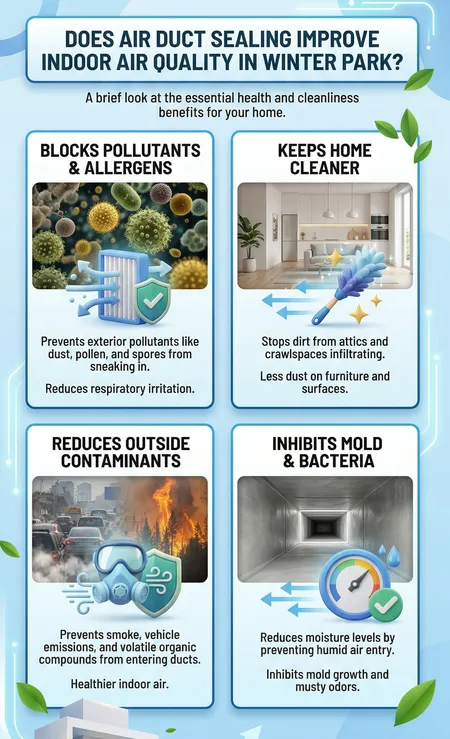
Air duct sealing directly improves indoor air quality by closing the gaps that allow unfiltered attic and wall air into the conditioned airstream — air that bypasses your filter on every single return cycle.
Leaky return ducts create negative pressure that actively draws contaminants in from unconditioned spaces. Your filter never sees them.
Winter Park homes face elevated risk due to year-round HVAC operation, persistent humidity, and overlapping oak and citrus pollen seasons.
Aeroseal seals from the inside, reaching gaps that surface patching can't touch — which makes it especially effective for Florida attic duct systems.
Central Florida homeowners typically see 15–25% reductions in cooling costs after duct sealing, with a break-even period of one to three years at current utility rates.
The improvement shows up fast. Less surface dust, more consistent temperatures, shorter HVAC cycles — most customers notice within the first week.
Duct sealing is a one-time structural fix, not a recurring expense. Results are confirmed by before-and-after pressurization testing before we leave the job.
How Leaky Ducts Affect Indoor Air Quality in Winter Park Homes
The Science Behind Duct Leakage and Pollutant Infiltration
Your duct system runs under pressure. Supply ducts push conditioned air out toward each room; return ducts pull room air back to the air handler. When gaps open at joints, seams, or connections — which happens gradually in most homes, especially in Florida's thermal cycling — that pressure differential becomes the real problem.
Return duct leaks create negative pressure inside the duct itself. That negative pressure doesn't just let conditioned air escape. It actively draws unfiltered air in from attics, wall cavities, or wherever the duct runs through unconditioned space. That air never touches the filter. It enters the living space directly, bypassing filtration entirely.
What we've found after years of inspecting homes across Winter Park: in most houses with attic duct systems, the worst-quality air in the building isn't coming from outside. It's coming from two feet above the ceiling.
What Winter Park's Climate Adds to the Problem
Winter Park's well-sealed, energy-efficient homes hold heat and humidity effectively. That's a good thing for most purposes. It works against you when your duct system is pulling attic air into the living space.
Attics here run hot and humid through most of the year. Oak pollen and citrus bloom overlap and stretch across nearly twelve months. Mold spores thrive in the persistent humidity. When return duct leaks pull that environment into the airstream on every cycle, the air your family breathes carries everything the attic holds — and your filter never processes any of it.
We see this in dust accumulation on registers, in how fast filters load up, and in the allergy complaints that homeowners write off as seasonal but that don't improve even when pollen counts drop.
What Air Duct Sealing Actually Does to Your Home's Air
Stopping Pollutant Infiltration at the Source
Duct sealing closes the entry points. Once those gaps are gone, the negative pressure in your return ducts stops pulling attic or wall air into the stream. The air handler draws only from the conditioned living space, passes it through the filter as designed, and redistributes it.
That's a more significant shift than most homeowners expect. Your filter was always capable of doing the job — sealing the ducts is what finally gives it the chance. Every cycle now processes only what it was designed to process.
Improving Airflow Balance and Filter Effectiveness
Duct leaks also disrupt pressure balance across the whole system. Rooms far from the air handler receive less airflow than they're supposed to. Rooms close to the handler get too much. The thermostat registers comfort unevenly, and the system runs longer trying to compensate for a problem that more runtime can't solve.
Sealing restores the pressure distribution the system was designed around. Rooms that run consistently warm start getting their share. The system reaches setpoint faster. Cycles shorten. And because airflow is balanced throughout the house, each pass through the filter actually processes the correct air volume — which means filtration works better without changing anything about the filter itself.
The Aeroseal Advantage — Why We Use It in Winter Park
Inside-Out Sealing vs. Traditional Mastic Methods
Traditional duct sealing means applying mastic paste to accessible joints and seams from outside the duct. In straightforward installations with good access, it gets the job done. In Florida attics with tight clearances, long flex duct runs, and connection points that are physically impossible to reach with a brush, the limits are real. You can only seal what you can touch.
Aeroseal works from the inside. The process pressurizes the ductwork and introduces a non-toxic water-based polymer aerosol into the airflow. The particles travel with the air to wherever gaps exist, accumulate there, and seal. Physical access doesn't matter — the process reaches every leak in the system, not just the convenient ones.
We use Aeroseal in Winter Park homes because the duct configurations we work with most — long attic runs, flex connections, cramped access throughout — respond better to interior sealing. Surface patching can't reach what the air has already been finding on its own for years.
What to Expect During a Professional Aeroseal Service
Most residential jobs are completed in a single day. Here's what the process looks like:
Pre-service inspection: We run a pressurization test to measure total system leakage before any work begins. You see the numbers upfront, not after.
Duct preparation: Registers and supply vents are temporarily blocked to isolate the duct system.
Aeroseal application: The sealant circulates through the pressurized system while a computer tracks leakage reduction in real time as each gap closes.
Post-service verification: A second pressurization test documents the total reduction achieved. You receive a printed performance certificate showing before-and-after measurements before our technician leaves.
The sealant is non-toxic and non-carcinogenic, with a long track record in hospitals, schools, and residential homes. There's no reason to vacate the home during service. No demolition, no wall access, no multi-day disruption.
Air Quality Benefits You'll Notice After Duct Sealing
Reduced Dust and Allergen Accumulation
The first thing homeowners notice after duct sealing is surface dust. Registers stay cleaner longer. Surfaces need less frequent wiping. In households with allergy sufferers, symptom frequency drops in the weeks following service — and customers tell us this directly.
The connection is straightforward. When unfiltered attic air stops entering the duct stream, the particulate load circulating through the home drops sharply. Less airborne debris means less deposition on surfaces, cleaner registers, and a meaningfully lower allergen concentration in every room.
In pet households, the effect is often sharper. Dander that was previously recirculating alongside attic-sourced particles now gets captured on each filter pass, the way the system was always designed to work.
More Consistent Temperatures and Fewer HVAC Cycles
Alongside dust reduction, the most consistent feedback we hear from customers after sealing is that the house just feels different. More even. Rooms that always run warm start holding the thermostat setpoint. The system cycles off more reliably because it's reaching that setpoint with less effort.
That matters beyond comfort. Fewer cycles mean less wear on the air handler and longer system life. In Winter Park, where humidity stays elevated through most of the year, more consistent cycling also means better moisture management — which directly affects mold spore levels throughout the living space.
Is Air Duct Sealing Worth It in Winter Park? (Cost vs. Benefit)
Average Energy Savings for Central Florida Homes
The return is higher here than in most U.S. markets. Leaky ducts waste energy in seasonal climates for eight or nine months a year. In Winter Park, they waste it every single month.
Homeowners in our service area typically see 15–25% reductions in cooling costs after a duct sealing service. At current OUC and Duke Energy residential rates, on a home running a three-ton or larger system daily, that translates to roughly $300–600 in annual savings — depending on home size, duct condition, and baseline leakage levels. Most break even within one to three years. For homes with significant pre-service leakage, it happens faster.
When to Seal vs. When to Replace Ductwork Entirely
Sealing is the right answer when the duct system is structurally sound but leaking at joints, seams, and connections. That's what we find in most of the homes we inspect in Winter Park.
Replacement is the right answer when structural integrity is already gone: collapsed or crushed flex duct, sections that have separated, systems degraded enough that sealing the surface won't restore real performance. Patching a compromised structure doesn't fix the structure.
When we inspect your system, we'll tell you honestly which situation applies. If sealing is the right answer, we'll show you the before-and-after numbers from the pressurization test. If you need a replacement instead, we'll say so directly — not after completing a job that won't hold.
"After years of inspecting attic duct systems across Winter Park, the pattern is consistent. The air quality problem in most of these homes isn't the outdoor environment, and it's not the filter. It's gaps in the return ductwork pulling attic air in on every cycle, air that bypasses the filter entirely. When we seal those leaks, we're not just cutting energy waste. We're changing what the household breathes every day. Most customers notice the difference within the first week."
Essential Resources
The following resources will help Winter Park homeowners make informed decisions about duct sealing and indoor air quality. Every source below is from a .gov or .org domain.
1. U.S. EPA — Energy, Weatherization, and Indoor Air Quality
The EPA's guidance on how duct system air sealing connects directly to indoor pollutant exposure — including why proper sealing is a core component of any home performance upgrade, not an optional add-on.
https://www.epa.gov/indoor-air-quality-iaq/energy-weatherization-and-indoor-air-quality
2. U.S. EPA — HVAC Systems and Indoor Air Quality Design Tools
Details how supply and return duct leakage causes measurable IAQ problems by allowing unplanned airflow between conditioned and unconditioned spaces — exactly the mechanism we identify in most Winter Park inspections.
3. ENERGY STAR — Benefits of Duct Sealing
ENERGY STAR's homeowner resource on the efficiency, comfort, and air quality improvements that duct sealing produces, including data on typical air loss rates in U.S. homes.
https://www.energystar.gov/saveathome/heating-cooling/duct-sealing/benefits
4. ENERGY STAR — Duct Sealing Overview
Practical guidance on the sealing process, when to hire a professional versus DIY, and where leaks most commonly form in residential duct systems.
https://www.energystar.gov/saveathome/heating-cooling/duct-sealing
5. U.S. Department of Energy — Minimizing Energy Losses in Ducts
DOE's Energy Saver resource on how duct leakage into unconditioned spaces adds hundreds of dollars annually to heating and cooling costs — with specific guidance on professional sealing as the solution.
https://www.energy.gov/energysaver/minimizing-energy-losses-ducts
6. CDC / NIOSH — Building Air Quality Guide
A joint EPA/NIOSH reference on preventing, identifying, and correcting indoor air quality problems, including the role of HVAC system integrity in maintaining healthy indoor environments.
https://www.cdc.gov/niosh/docs/91-114/default.html
7. NATE — HVAC Technician Certification Standards
The industry standard for technician competency. Any duct sealing work should be performed by NATE-certified technicians who've demonstrated real-world knowledge of HVAC systems, airflow, and installation standards — not just classroom hours.
https://natex.org/technician/become-nate-certified/getting-started-2
Supporting Statistics
Stat 1: Homes lose 20–30% of conditioned air through duct leaks
ENERGY STAR's research shows the average U.S. home loses 20 to 30 percent of conditioned air through duct leaks, holes, and poorly connected ductwork — before that air ever reaches a room. In a Winter Park home running its system every month of the year, that loss isn't a seasonal inconvenience. It's a constant drain on every dollar your system produces. Sealing those leaks is the most direct way to recover what you're already paying for.
Source: ENERGY STAR — Benefits of Duct Sealing
Stat 2: Leaky ducts can add hundreds of dollars per year to energy bills
The U.S. Department of Energy confirms that ducts leaking conditioned air into unconditioned spaces like attics can cost homeowners hundreds of dollars annually in unnecessary energy expenses. In Central Florida, where cooling demand doesn't let up, that figure compounds year over year. Properly sealed ducts stop that loss before it appears on your next OUC or Duke Energy statement.
Source: U.S. Department of Energy — Minimizing Energy Losses in Ducts
Stat 3: Sealing duct leaks prevents contaminants from entering and circulating through the home
EPA guidance on indoor air quality confirms that tightly sealed ductwork prevents contaminants from entering and circulating through the home — and that leaky return ducts specifically create the negative pressure conditions that draw in pollutants from unconditioned spaces. This is precisely what we identify in attic duct systems across Winter Park. More filtration doesn't solve this problem. Closing the entry point does.
Source: U.S. EPA — Energy, Weatherization, and Indoor Air Quality
Final Thoughts and Opinion
Duct sealing is the most underutilized home improvement in Winter Park. That's our honest assessment after inspecting hundreds of duct systems across this service area, and we'll stand behind it.
Here's the case plainly: Central Florida homes run their HVAC systems every month of the year. The humidity is persistent. Pollen seasons stack on top of each other. Homes are built tight, which means the quality of what circulates through the duct system matters more here than in almost any other region. When that system is leaking — and statistically, most are — every hour the handler runs is another hour delivering substandard air to the people living in that house.
The good news is that this is a solvable problem. A single day of work with measurable, documented results. A structural improvement that holds, not a recurring maintenance item. And unlike most home improvements, the performance is verified before the technician leaves. You see the before. You see the after. The numbers are on paper.
What we tell every homeowner we sit down with in Winter Park is the same thing: you're already paying for clean, conditioned air. The only question is whether your duct system is actually delivering it. If it isn't — and we'll show you the data to know for certain — sealing it is the fastest way to start getting what you're already paying for.
You're the one who keeps this home running. Knowing what's happening inside your ductwork, and acting on it, is exactly what that looks like.
Frequently Asked Questions
1. Does air duct sealing actually improve indoor air quality?
Yes, and the mechanism is specific. When return ducts have gaps, negative pressure draws unfiltered air from attics, wall cavities, and crawl spaces directly into the airstream — completely bypassing the filter. Sealing those gaps eliminates the entry point. Once sealed, the only air your system processes is air drawn from the conditioned living space, filtered, and redistributed. Most homeowners notice a reduction in dust and allergy symptoms within the first week of service.
2. How do leaky ducts affect the air my family breathes in Winter Park?
In most Winter Park homes, duct systems run through the attic space. Florida attics are hot, humid, and hold a steady load of particulates year-round — insulation fibers, mold spores, and seasonal pollen from the oaks and citrus that make this area beautiful to live in. When return ducts have gaps, every HVAC cycle pulls some of that attic environment into the duct stream. Your filter doesn't catch it. It goes directly into the rooms where your family spends their time. Over a year of continuous operation, the cumulative exposure is significant — especially for children, older residents, or anyone managing asthma or allergies.
3. How long does air duct sealing take in a typical Winter Park home?
Most residential jobs finish in a single day. Our process starts with a pressurization test that quantifies existing leakage, then moves through the Aeroseal application, and closes with a second test that documents exactly how much leakage was reduced. You'll have a printed performance certificate showing the before-and-after numbers before our technician leaves your home. The process doesn't require demolition, ceiling access, or any reason to leave during service.
4. What's the difference between duct sealing and duct cleaning?
Duct cleaning removes accumulated debris — dust, mold, and biological material — from the interior surfaces of your ductwork using specialized vacuum and brush equipment. Duct sealing closes the structural gaps that cause air loss and allow contaminant infiltration. They address different problems. Cleaning addresses what's inside the ducts. Sealing addresses what gets in and what escapes. In most Winter Park homes we inspect, duct leakage is the primary issue, and sealing produces the more immediate and lasting air quality improvement. When both services are warranted, we'll tell you that directly.
5. How much can I save on energy bills after sealing my ducts in Winter Park?
Most homeowners in our service area see 15–25% reductions in energy costs following duct sealing. The exact figure depends on your home's square footage, duct configuration, current leakage levels, and HVAC system size. Because Winter Park homes run cooling systems every month of the year, the annual savings potential here exceeds what you'd see in most seasonal climates. At current OUC and Duke Energy rates, that typically means $300–600 in annual savings for a mid-size home with significant pre-service leakage. We can give you a more specific estimate based on your system's actual pressurization test results.
Your HVAC Is Already Producing Clean Air — Your Ductwork Decides Whether It Arrives
If your home has been running its system for years without a duct inspection, there's a real chance a significant percentage of that conditioned air is escaping before it reaches a room — and attic air is coming in to fill the pressure gap. Schedule your free duct inspection today, and let our NATE-certified team show you exactly what we find, what it's costing you, and how we fix it, usually in a single day.
Here is the nearest branch location serving the Winter Park area. . .
Filterbuy HVAC Solutions
2900 Titan Row # 128, Orlando, FL 32809
(407) 204-1859
https://maps.app.goo.gl/Weuf8AhtuRP4H855A